After reconciling your checking account, you generate your final profit and loss statement for the year showing a $40,000 profit. With the checking account in your books matching your bank statement, you’re about to send the P&L to your tax preparer. However, you decide to check one more thing. You look into the detail of your advertising expense. Do your advertising expenses include the charge from the company that placed your ad? Do they also include the payment you made to the credit card company?
If both are in there, your business is showing it paid for an ad twice. Your bank account can still balance to the penny.
Ruth White, EA and co-founder of White Sands Tax Services, suggests looking at four common bookkeeping mistakes prior to filing your taxes. You’ll need your profit and loss statement and your balance sheet. Have your loan and credit card statements handy so you can check the entries against them.
What is a profit and loss statement?
A profit and loss statement shows your business revenues and expenses for a given time period. The difference is your profit or loss for that period. Your business may show a loss for one month even if it made money for the year. Your balance sheet shows what your business owns and owes on a specific date. That’s where you’d look for a piece of equipment the business owns and, separately, the amount you still owe on it.
Before getting too far into the numbers, read the dates at the top. If you file on a calendar-year basis, the P&L should cover January through December. The balance sheet needs just one date, December 31. Note the method of accounting, too. A P&L may be shown on either a cash or an accrual basis. Think of a December job that the customer pays for in January. If you finished the job and sent the invoice in December, you’d generally see the income in December on the accrual report and in January on the cash report.
1. Expensing the entire loan payment
A bakery owner looking through the checking account sees a $750 withdrawal for the oven loan. There’s no breakdown on the bank statement. The loan statement shows where the money went. This month, $610 paid down the loan and $140 went to interest. Of that $750 payment, only the $140 is a potential business interest deduction. The bakery accounts for the cost of the oven itself separately.
Take the statement from the lender and compare it to the same payment in your books. Look over your loan balance. If you have paid down the loan and your books still reflect the initial loan amount, take a look at how your payments are classified. Even when the same amount is withdrawn from the bank each month, the amounts applied to principal and interest can vary.
2. Counting an advertising expense twice
Suppose you charge $2,000 for an advertisement on your business credit card. You would classify the charge as an advertising expense. Later, when you pay the credit card bill, the withdrawal comes through your bank feed. It’s easy to remember what the $2,000 was for and select advertising again. Open the advertising account now and you’ll find $4,000 for a single ad.
Keep the advertising charge under the name of the company that placed the ad. Record the payment from checking against the balance you owe on the credit card. In QuickBooks Online, you can do this using the “Pay down credit card” feature. Already entered the payment? When the withdrawal shows up in the bank feed, match it to the payment you entered. The original charge stays right where it was.
3. Reporting a business line of credit as income
Say a contractor is waiting on a customer to pay and draws $20,000 on a business line of credit in December. The deposit comes through the same checking account where the customer usually sends payments. The contractor owes that $20,000 back to the lender. Entering it as a sale would make December’s revenue and profit look $20,000 higher than they were.
The place to record the borrowing is the line-of-credit account on the balance sheet. Repaying the $20,000 of principal does not create a business expense for the contractor and, therefore, does not reduce profit. If the contractor pays it back in January and expenses the repayment, the error shows up on the following year’s P&L. Anything the contractor bought with the money is accounted for according to what was purchased.
One way to spot this is to pull up the deposits that went into December sales. Pick out the $20,000 and see whose name is on it. The credit-line statement will show when the draw occurred and the contractor’s obligation at the end of the year.
4. Missing interest you’ve actually paid
You can also fail to account for interest paid by applying too much of a loan payment to the principal. This results in an understatement of interest expense in your P&L. You can get a statement from your lender that lists the interest paid during the year. Compare it to the amount of interest expensed in your books for that loan.
For example, if a sole proprietor charged a family vacation and business advertisements to a business credit card, the credit card company would report the interest charge to the business owner. It wouldn’t tell the owner how much of that interest went with the vacation. For federal tax purposes, the use of the borrowed money generally determines which portion can qualify as business interest. The owner needs the purchase records to work that out.
Identify a mixed-use loan or card to your tax preparer. Other rules may also limit your deduction of business interest expense.
How $40,000 in book profit becomes $57,800
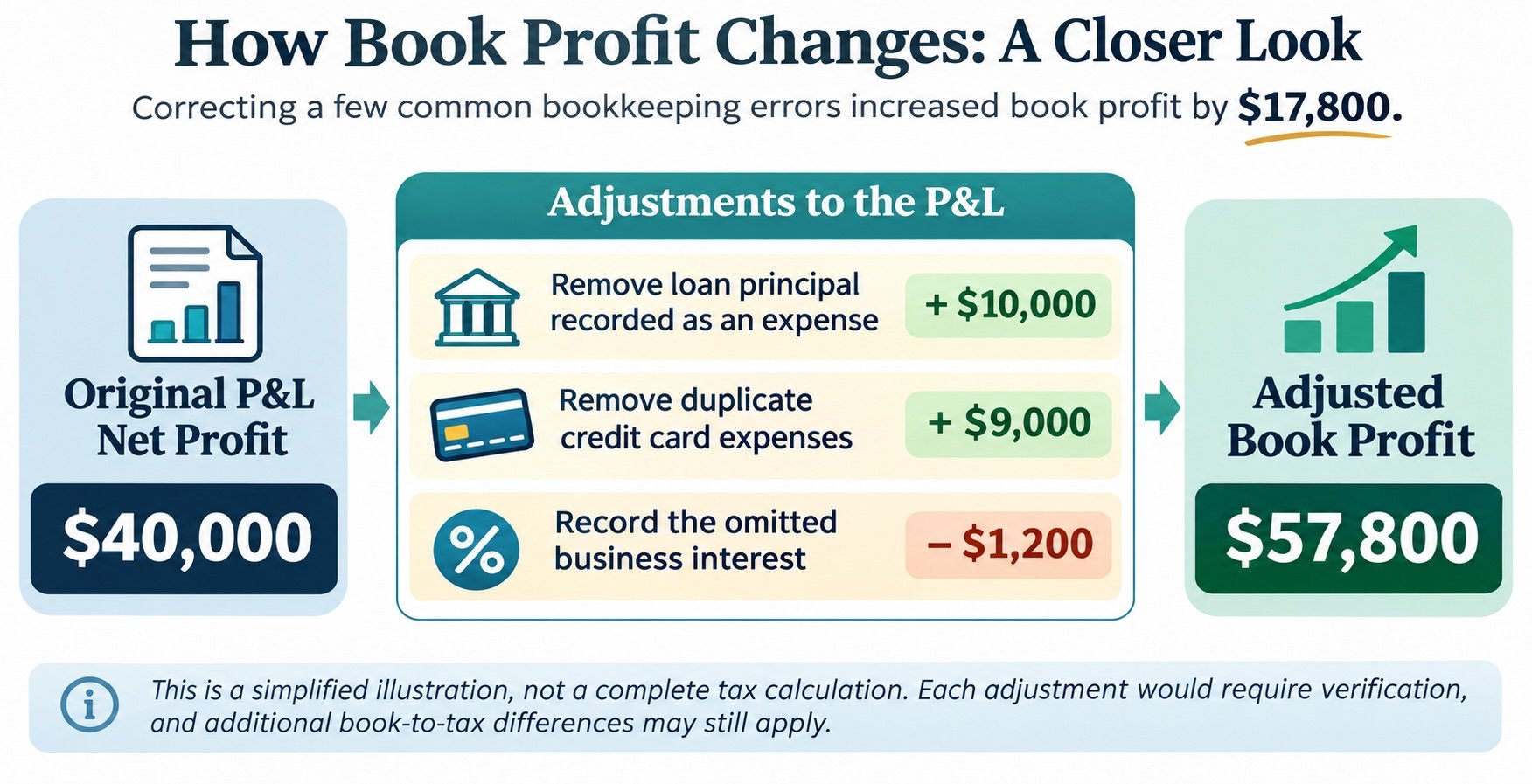
Infographic showing how correcting bookkeeping errors changes reported profit from $40,000 to $57,800 by adjusting loan principal, duplicate credit card expenses, and omitted business interest.
Go back to the $40,000 at the bottom of your P&L. Imagine pulling the statements and finding three things. The business repaid $10,000 in loan principal and put the payments in expenses. Another $9,000 went to pay the credit card bill after the business had already recorded the purchases. Those payments went in expenses, too. On a separate loan, the lender’s records show $1,200 in qualifying business interest paid during the year. That interest is missing from the P&L.
EntryAmountNet profit on the original P&L$40,000Remove loan principal recorded as an expense+$10,000Remove duplicate credit card expenses+$9,000Record the omitted business interest−$1,200Adjusted book profit$57,800
The book profit adjustment does not change the cash in the bank. It leaves you with $17,800 more in book profit than the original P&L showed. Your preparer can now use the $57,800 figure to work through any adjustments needed on the tax return.
Why a bakery’s P&L may differ from its tax return
Using the bakery example again, the cost of the oven may be spread over a number of years for financial reporting purposes. For taxes, a detail worth saving is the date the oven was ready to use. If it sat in the kitchen waiting for a gas hookup in December, and the installer got it working in January, the bakery generally starts depreciating it in January. Qualifying equipment may be eligible for a larger first-year deduction. The owner can still be making payments on it years later.
Meals provide an easy case study. If a business owner pays $80 for a qualifying client lunch, the expense can be recorded as such. Applying the general 50% limit, the federal tax deduction would be $40. Bookkeepers should not change the expense from $80 to $40 to account for the 50% limit.
What to gather before sending your P&L
The final P&L for the tax year and the balance sheet as of year-end. If there are entries in a given category that you don’t understand, ask for a transaction detail report.
Bank and credit card statements for all business accounts, including accounts that were closed during the year.
Statements for business loans and lines of credit, including year-end statements that show the principal and records of the interest paid. For new loans, provide the loan documentation.
Invoices and use records for equipment. Include when it was ready for use in the business. If equipment was used personally as well, provide a record of both uses.
Your tax preparer may ask for statements and other records to understand particular transactions, or for accountant access to look up an entry. A brief explanation from you can help. “I drew on the credit line while I was waiting for a customer to pay” gives the preparer something to check against that December deposit.
Things to do now
Reconcile each of your business bank and credit card accounts to its statement.
Compare your loan balance with what your lender has recorded. Make sure your interest expense is recorded.
Keep your receipt and jot down the date and what the expense was for while you remember it.
You can do these things as part of your normal bookkeeping. You can also use our year-end tax checklist to help you collect your tax documents. White Sands Tax Services provides tax preparation and bookkeeping for small businesses in Long Beach and remotely throughout the U.S. You can schedule a consultation if something looks amiss in your records before filing.
This article provides general information about federal taxes. The tax treatment depends on your business and the nature of each transaction.