Typically, yes. An LLC may need to pay the $800 annual tax and file a California return regardless of whether it earned any money. Factors including how the LLC was taxed and what occurred during the year affect whether the LLC must also file a federal return. There are some exceptions, though, and they are worth understanding before deciding what to file or pay.
Let's say you created an LLC to start a business and then ceased pursuing the business. For example, you never created any business sales invoices or opened a business bank account. You may think that you don't need to file a business return.
Before putting the formation documents away, consider whether you want to continue the business. Also, find out what California requires of a business you are no longer using. Our article on tax and accounting requirements that online LLC formation services often miss explains some of the responsibilities that can be overlooked after forming an LLC.
What Do You Mean by "The LLC Made No Money?"
An LLC may not have made money if its expenses and costs exceeded its income, or if it had no income at all. These situations are not necessarily treated the same for tax purposes.
No revenue: The LLC did not earn any sales or other business income. It may still have incurred expenses.
No profit: The LLC received income, but its expenses were equal to or greater than that income.
No activity: Depending on what "no activity" means, the LLC might never have started running its business. Registration and filing history are still important to evaluate.
Look beyond the sales total. You need to review and analyze all expenses and costs associated with starting and running the business. Expenses incurred before a business begins operating may be treated differently from ordinary business expenses, particularly when determining when they can be deducted. Having no sales does not necessarily mean the business had no expenses.
Why Does California Charge $800 When an LLC Has No Income?
Generally, LLCs that are taxed as partnerships or disregarded entities are charged the $800 annual tax if the LLC is organized in California, registered with the California Secretary of State, or doing business in California. The tax is not based on the LLC's profit.
Therefore, an LLC that has no business activity can still be required to pay the $800 annual tax.
People often claim California does not charge the $800 annual tax in the first year of the LLC's existence. The first year's tax was temporarily waived for qualifying LLCs organized or registered during 2021 through 2023. Therefore, a California LLC formed in 2026 is not automatically exempt from the $800 annual tax in its first year. Certain exceptions may still apply.
The $800 annual tax is also separate from the additional California LLC fee. This additional fee applies when an LLC has total income attributable to California of $250,000 or more, calculated under the state's LLC fee rules. Like the $800 annual tax, the fee is not determined by the LLC's net profit. Thus, an LLC with genuinely zero income would not owe the additional LLC fee, even though it may still owe the $800 annual tax.
Will Your LLC Require You to File Both Federal and California Returns?
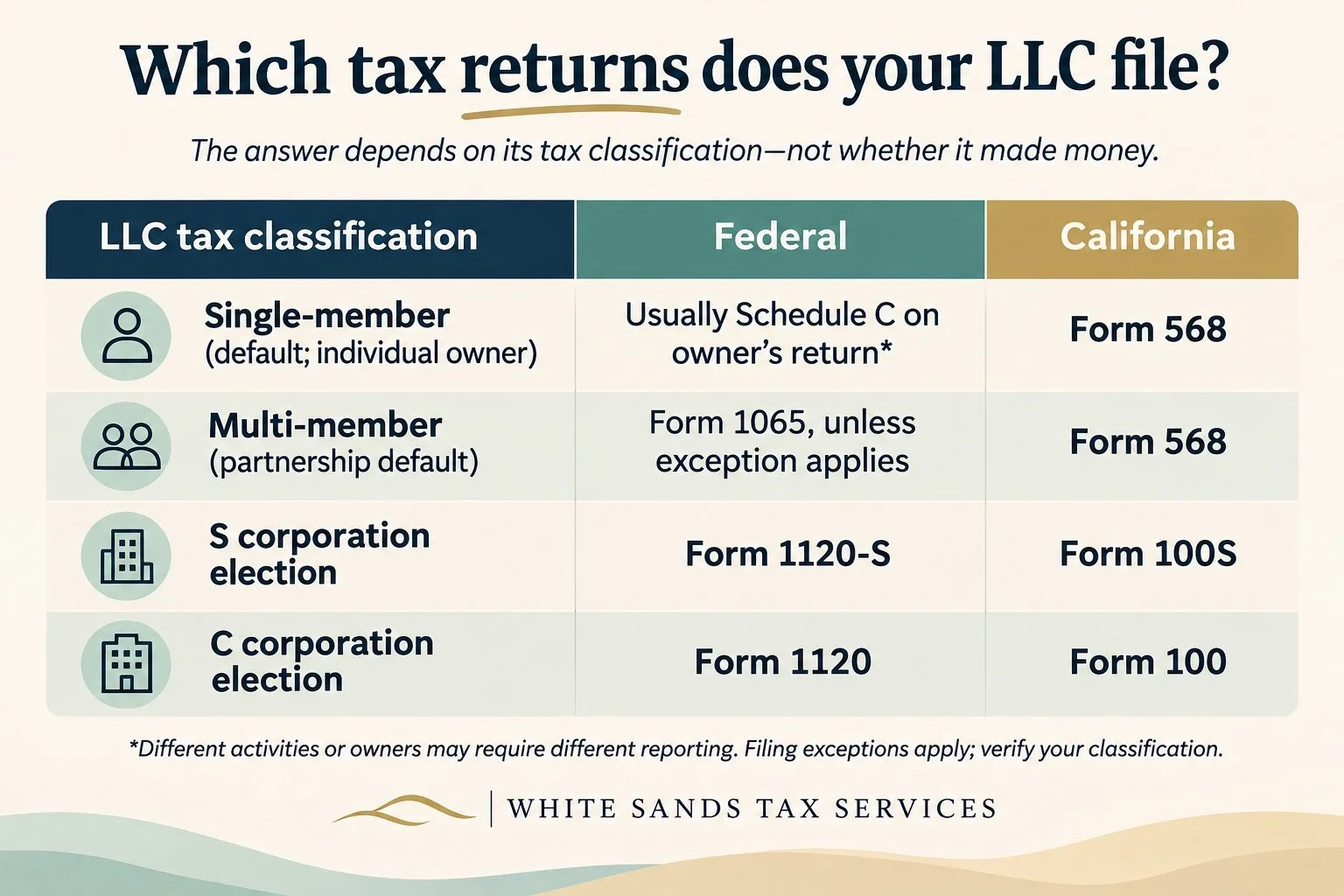
Comparison of federal and California tax forms for single-member LLCs, multi-member LLCs, S corporations, and C corporations.
The LLC's tax classification is key. The phrase "LLC" does not provide this information. Depending on the number of owners and whether the LLC has made a tax election, different filing rules apply.
A Single-Member LLC That Has Not Elected to Be Treated as a Corporation
An LLC with a single member is often "disregarded" for federal income tax purposes. This generally means the LLC does not file a separate federal income tax return. Instead, its business activity is reported on the owner's federal return.
If the member is an individual and the activity involves an ordinary trade or business, it will generally be reported on Schedule C. Rental or farming activities may need to be reported on different schedules.
Disregarding the status of the LLC for federal income tax purposes does not eliminate the LLC for California tax purposes. Therefore, a California single-member LLC that is disregarded for federal tax purposes generally must still file California Form 568.
The owner's business income and expenses are also reported on the appropriate federal and California income tax returns. Form 568 does not replace those filings.
An LLC That Has Been Classified as a Partnership for Federal Tax Purposes
A multi-member LLC will generally be taxed as a partnership for federal tax purposes unless it has made an election to be treated as a corporation. The federal partnership return is Form 1065.
Generally, a domestic partnership will not be required to file Form 1065 if the partnership had no gross income for the year and did not pay or incur expenses treated as deductions or credits for federal income tax purposes.
Both conditions are important. The lack of sales does not prove that expenses were not incurred. Likewise, the payment of a formation fee does not mean that all expenses of starting a business are immediately deductible. The specific facts and circumstances of each expense must be analyzed.
It is important to note that the exception provided by the IRS does not automatically eliminate California's filing requirements. Thus, an LLC formed under California law may still be required to file Form 568 and pay the $800 annual tax, even if it does not need to file federal Form 1065.
An LLC That Has Made an S Corporation or C Corporation Election
An LLC that has made an S corporation or C corporation election is treated as a corporation for income tax purposes. Thus, an LLC with an effective S corporation election generally files California Form 100S and federal Form 1120-S. On the other hand, an LLC taxed as a C corporation generally files California Form 100 and federal Form 1120.
The filing requirements for corporations generally continue even when they have no income.
It is also important to note that California's corporate minimum franchise tax rules are different from the annual tax rules for LLCs treated as partnerships or disregarded entities. A corporation may owe the $800 minimum franchise tax even when it has no taxable income. However, newly formed or qualified corporations, including eligible LLCs taxed as corporations, may qualify for a first-taxable-year exemption from the minimum tax.
The California Franchise Tax Board provides additional guidance on LLCs treated as corporations.
There may be LLCs with election records that are not required to file Form 568 because they are taxed as corporations. Thus, before preparing a return, there is a need to determine whether a corporate election was made and whether it is still in effect.
The $800 Payment and the Return Are Due on Different Dates
The annual tax for LLCs taxed as partnerships or disregarded entities is generally assessed and due during the year. The return is usually due the following year.
For an LLC with a calendar-year tax year, the $800 annual tax is generally due April 15 of that year. For example, the 2026 annual tax for an established calendar-year LLC was generally due April 15, 2026.
A newly formed California LLC must make its first payment within a few months of formation. The deadline is the 15th day of the fourth month after the LLC's taxable year begins. An LLC formed in June would generally have its first payment due September 15.
California's filing deadlines depend on how the LLC is taxed. Form 568 for a calendar-year LLC treated as a partnership is generally due March 15 of the following year. An individual-owned single-member LLC that is disregarded for federal income tax purposes generally has until April 15. Different ownership or tax classifications can change the return deadline.
Reporting dates may also change due to weekends, holidays, or applicable disaster relief. The FTB publishes the applicable business tax return and payment deadlines.
An extension to file gives no extension to pay. Filing and paying are two different actions. An LLC may have paid the entire $800 annual tax and still be required to submit Form 568.
If the LLC Was Never Used, It May Be Eligible for Short-Form Cancellation
California LLCs that do not transact any business may qualify for short-form cancellation within 12 months of filing their Articles of Organization.
Merely failing to use an LLC does not result in its cancellation. To complete the cancellation, the LLC must file a Short Form Cancellation Certificate, Form LLC-4/8, with the California Secretary of State.
Cancellation cannot be completed under this process if the LLC has conducted business since its formation. The LLC must also have no debts or other liabilities except qualifying tax liabilities, and it must have distributed its known assets to the persons entitled to them or have no known assets.
There are other requirements. The appropriate members or managers must approve the cancellation, payments received from investors for interests in the LLC must have been returned, and the LLC must have filed or state that it will file a timely final California LLC return.
When the LLC qualifies and the short-form cancellation is properly completed, it is not subject to the $800 annual tax for its first tax year. However, the FTB has taken the position that the cancellation does not entitle the LLC to a refund of annual taxes or fees already paid for that first year.
Just because an LLC has not received any money does not mean the LLC has not conducted business. The LLC's records must be reviewed in order to make that determination.
An Exception for Very Short Tax Years
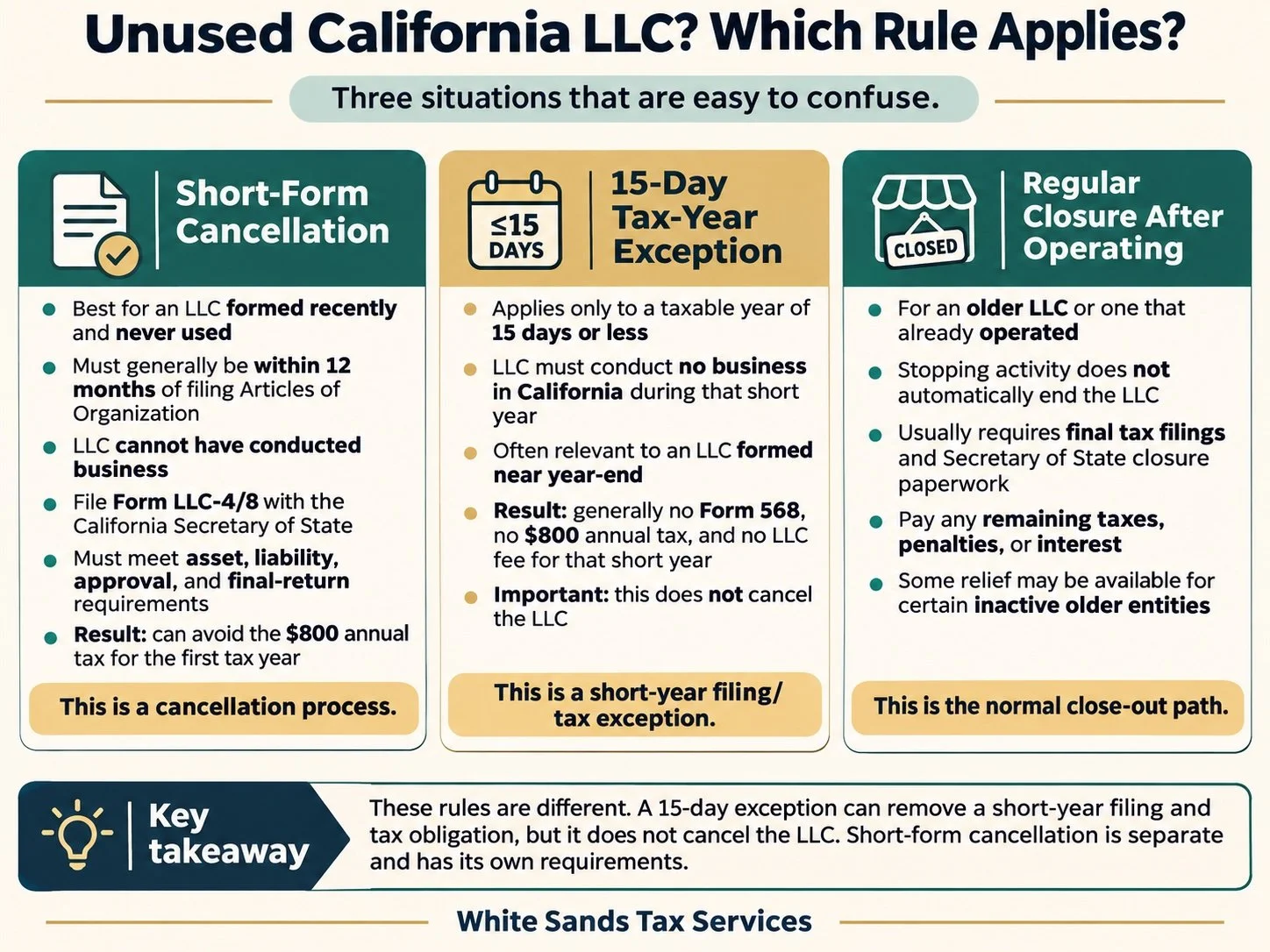
Guide comparing California LLC short-form cancellation, the 15-day tax-year exception, and regular business closure requirements.
There is another exception worth knowing about, particularly for businesses formed near the end of the year.
An LLC that conducts no business in California during a taxable year of 15 days or less generally is not required to file a California return or pay the annual tax or LLC fee for that short tax year.
Consider a calendar-year LLC formed on December 20 that conducts no business for the remainder of the year. Because the tax year is less than 15 days and the LLC conducted no business, it would generally qualify for this exception. It would not be required to file Form 568 or pay the $800 annual tax for that short period.
The exception does not automatically carry over into the following year. The LLC may become subject to the normal filing and payment requirements once the new tax year begins.
How long an LLC is in existence and how long it actually conducts business are two different things. An LLC that exists for the entire year will not qualify for the 15-day rule simply because it operated for fewer than 15 days.
The FTB discusses the 15-day exception and its requirements in its Limited Liability Company Filing Information publication.
What if the LLC Was in Existence for the Entire Year but Operated for Only Part of It?
Operating the LLC for a period of time and then ceasing to do so does not, by itself, cause the LLC to cease to exist.
From a legal and tax perspective, stopping business operations and formally cancelling the LLC are different actions. It may be necessary to file dissolution and cancellation documents with the Secretary of State, along with completing the final tax filings and addressing any remaining liabilities.
Timing can make a difference. For example, California provides relief from the annual tax for a subsequent year when an LLC timely files its final return for the preceding taxable year, stops conducting business, and completes the appropriate Secretary of State cancellation paperwork within 12 months of filing that final return.
Whether this relief applies will depend on the LLC's filing history, when it stopped doing business, and whether the appropriate documents were submitted on time.
The FTB's Guide to Dissolve, Surrender, or Cancel a California Business Entity explains these requirements in greater detail.
What Happens When an LLC Is Formed but Not Used?
Don't automatically think that you need to file the same corrections for each year. It's possible that different forms were required or filed in past years, particularly if the LLC's ownership or tax classification changed.
You will want to collect the Articles of Organization, information about owners, tax election forms, previous returns and notices, payment confirmations, bank and credit card statements, personally paid business expenses, and information about when the business opened, closed, or whether it ever opened.
If required returns are not filed or taxes are not paid, penalties and interest may accrue. Not having income during a tax year is not necessarily a reason to avoid filing a return. Penalties can still apply.
If your records are incomplete or several years of tax filings are missing, our article on how to catch up on unfiled taxes explains how to begin organizing the information needed to address outstanding filings.
There are programs that may provide relief. For example, certain LLCs formed in California and registered for more than 12 months that have stopped doing business or never conducted business and have no assets may qualify for voluntary administrative cancellation.
Under this program, the California Franchise Tax Board may abate qualifying unpaid taxes, penalties, fees, and interest for periods when the LLC was no longer doing business. However, the program generally does not eliminate tax liabilities from periods before the business stopped operating.
Applying for relief through the FTB does not, by itself, legally terminate the business. The appropriate cancellation paperwork must still be completed with the California Secretary of State.
An older, unused LLC should be reviewed to determine what actually happened during its existence rather than simply paying the latest tax notice or ignoring its filing history.
Consider Keeping Your LLC or Completing Its Closure
Sometimes business owners close their doors due to poor business conditions. Other times, the business simply never gets started. Before deciding what to do with your LLC, there are a few things to consider.
An LLC may be disregarded for federal income tax purposes but still remain a registered business entity in California. Consequently, even if your LLC has no income or customers, it may still be required to file California returns and pay the applicable annual tax.
If you plan to keep the LLC, you should make sure its tax filings, payments, and state registration requirements are current. If you have no plans to continue the LLC, it may be better to complete its closure rather than allow additional obligations to accumulate.
White Sands Tax Services provides tax and business services to LLCs throughout California. If your LLC needs tax returns prepared or you are uncertain about its filing obligations, we can assist you.
During your consultation, we can review which tax returns are necessary, whether outstanding tax obligations need to be addressed, and the potential tax consequences of closing your LLC. We can also help you understand the tax-related steps that should be completed as part of the cancellation process.
Schedule a free consultation with White Sands Tax Services to discuss your LLC's tax filing requirements.
This article was prepared by White Sands Tax Services. It is for general information only and does not constitute individualized tax or legal advice. Requirements for filing or closing an LLC vary based on ownership, tax classification, business activity, and other factors.